Governance for
cyber-risk decisions.
DeGoyle turns relevant cyber intelligence into accountable decisions, residual risk visibility, and board-ready evidence — purpose-built for Irish critical infrastructure operators preparing for NIS2 and CER.
Built for CISOs, risk leaders, executives, and boards responsible for evidencing cyber-risk governance across critical operations.
Illustrative product preview
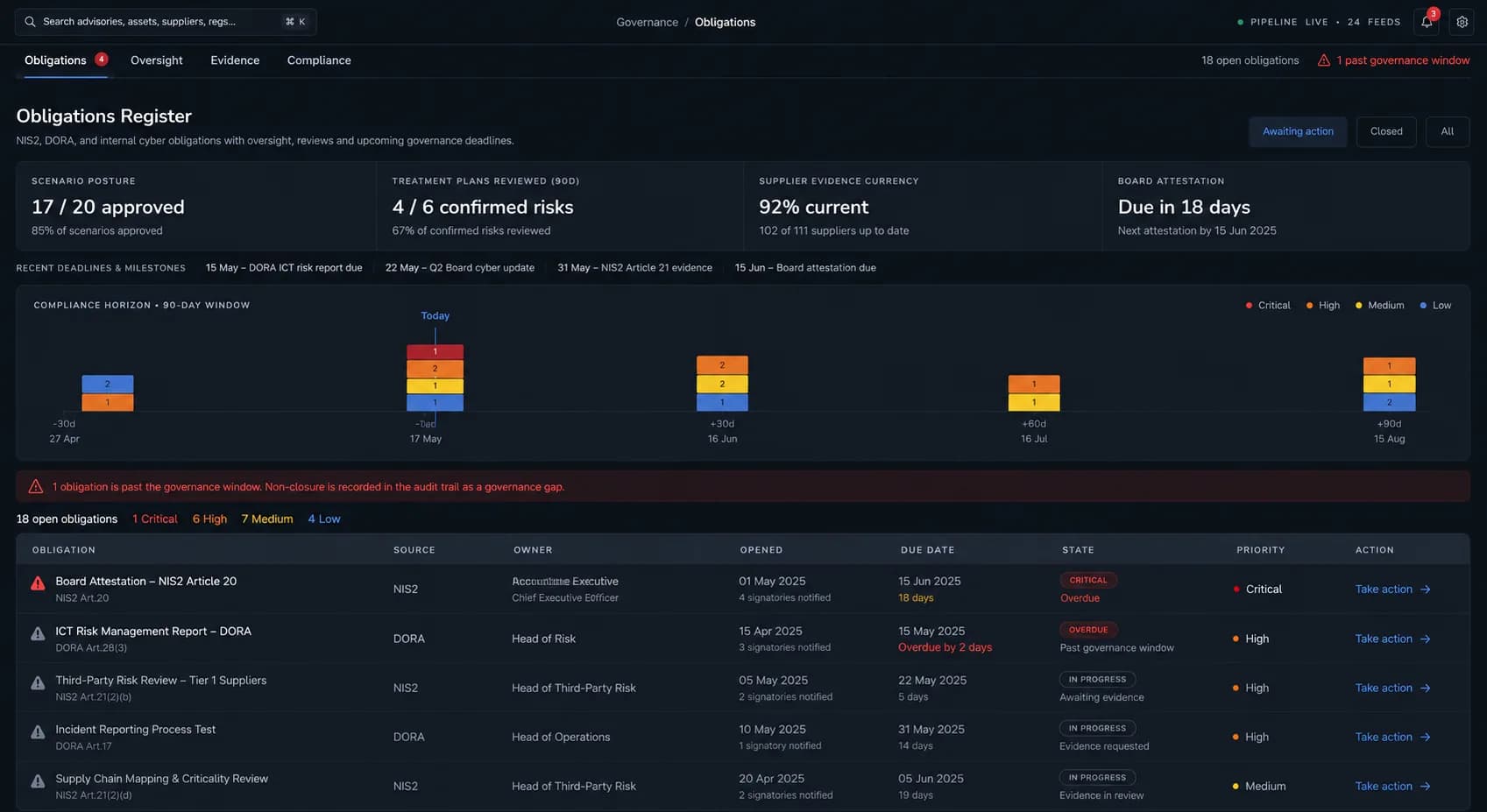
Cyber governance is still managed through disconnected systems.
Boards and executives are being asked to govern cyber risk using scattered technical reports, manual evidence packs, and risk registers that are hard to interrogate and harder to defend under scrutiny.
No structured decision trail
When a regulator asks who approved a risk treatment and when, the answer is often a chain of emails — not a governance record.
Technical signals without business context
Vulnerability advisories reach the board without the contextualisation needed to approve or escalate with confidence.
Evidence assembled after the fact
Compliance evidence is built retrospectively — inconsistently, under pressure — rather than recorded as decisions are made.
Every signal,
mapped to what matters.
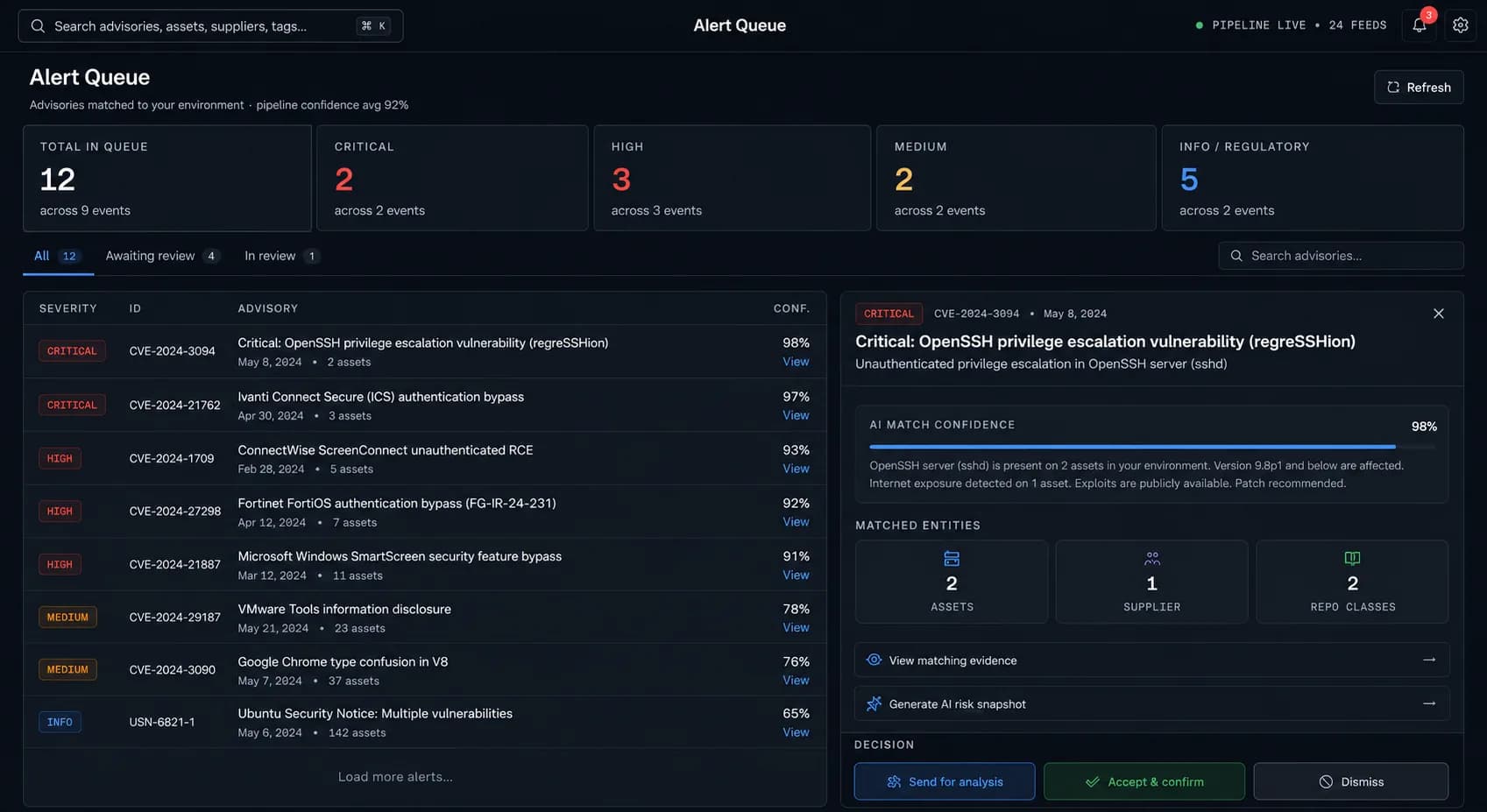
Connect incoming cyber advisories to the assets, suppliers, and dependencies that actually matter to your operating environment — not a generic threat feed.
- ✓Configurable ingestion of advisories, CVEs, and sector alerts
- ✓Mapped to your asset, supplier, and dependency graph
- ✓Filtered to risks relevant to essential operations
- ✓Re-scoring as asset, supplier, and dependency context changes
Named decisions.
Evidenced sign-offs.
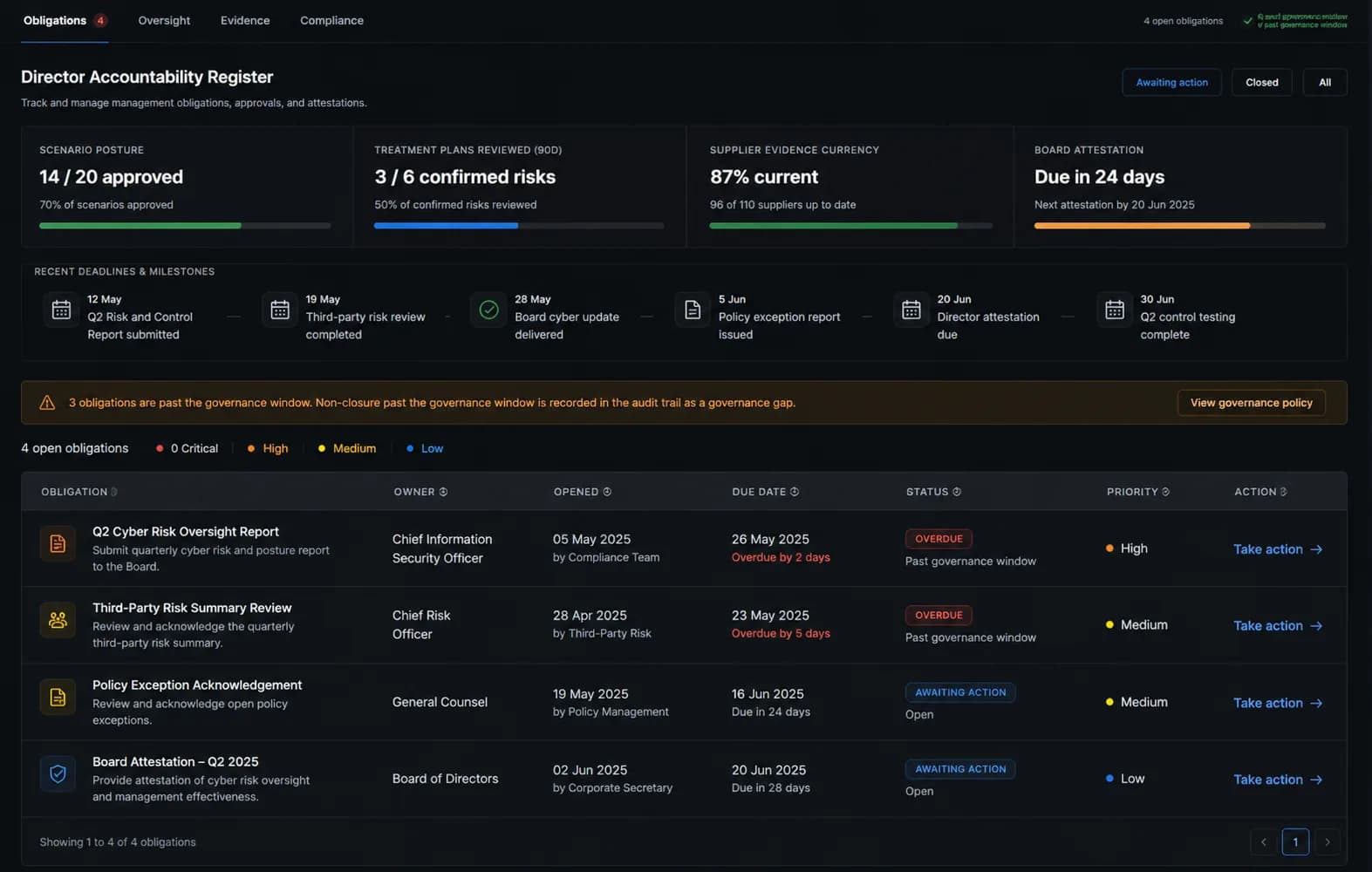
Under NIS2 Article 20, management bodies must approve cybersecurity risk-management measures and oversee implementation. DeGoyle supports a defensible governance workflow — every decision named, timestamped, and linked to the scenario it addresses.
- ✓Management-body approval workflow with named owners
- ✓Pending action queue surfaced to the board
- ✓Controlled audit trail of every sign-off
- ✓Evidence packs structured for regulator, auditor, and board review
Test every scenario.
Know where you stand.
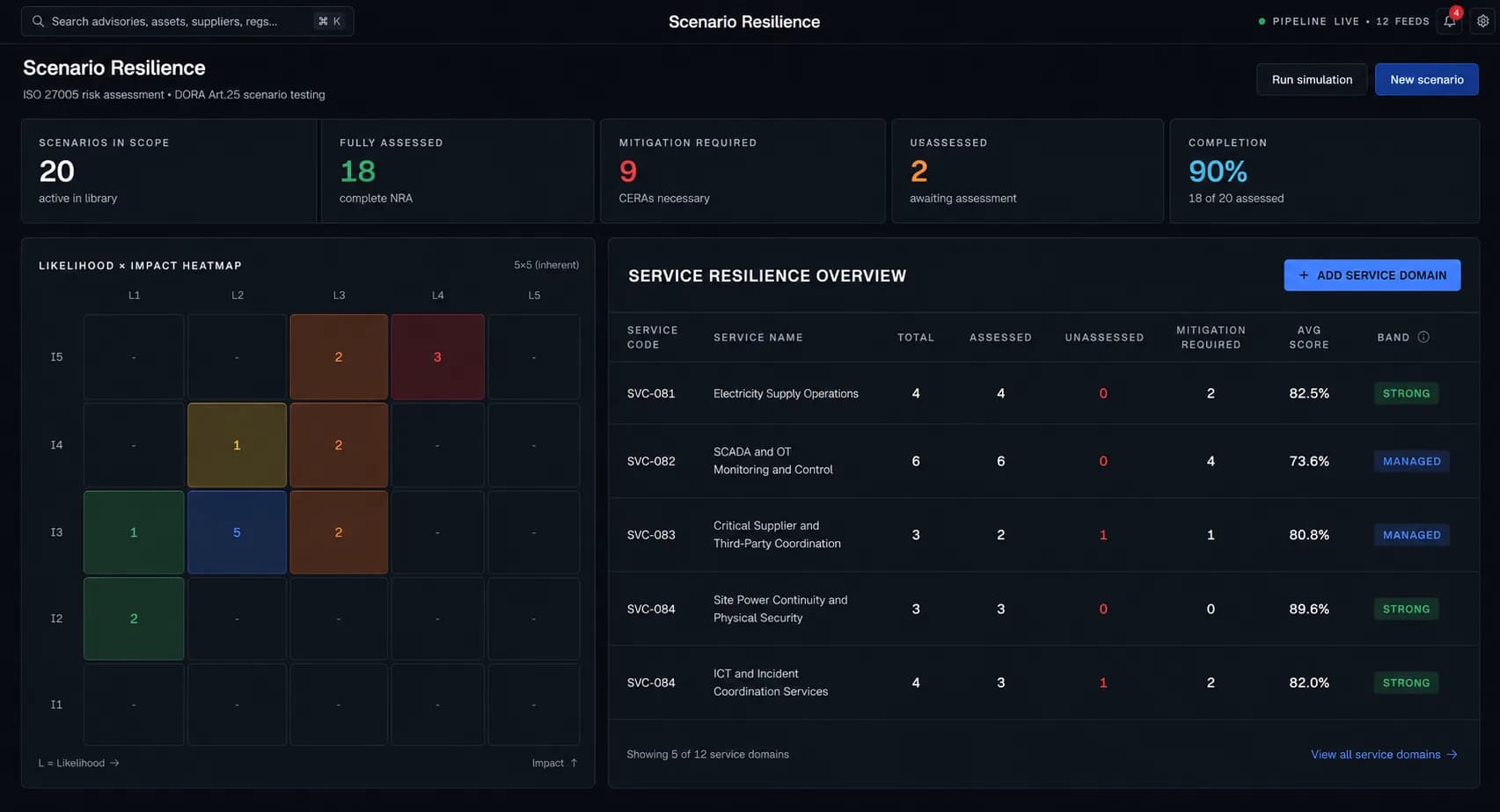
Run structured assessments against realistic cyber scenarios mapped to your operating environment. The heatmap makes likelihood and impact visible across all service domains — so the board sees posture at a glance, not a report.
- ✓Scenarios mapped to critical infrastructure sectors
- ✓Likelihood × impact heatmap with inherent and residual views
- ✓Per-service resilience scoring across all operating domains
- ✓Assessment completion tracking for regulatory obligations
From external intelligence
to accountable governance.
A governed workflow connecting cyber events to leadership review, treatment oversight, and structured evidence — without collapsing the line between operations and the board.
Signal intake
Cyber advisories, vulnerability disclosures, sector alerts, and dependency context — curated for relevance to essential operations.
Exposure mapped
What is affected, where it matters, and how it connects to the operations you cannot afford to let fail.
Board and executive review
Decision-ready risk context for named approval. Treatment, residual exposure, and sign-off status — in one place.
Structured evidence output
A controlled trail of decisions, sign-offs, and escalations — structured for board reporting, audit review, and regulatory scrutiny.
DeGoyle helps convert cyber-risk signals into governed decisions, named ownership, treatment visibility, and structured evidence for leadership review — without collapsing the line between operations and the board.
Core workflows for governing cyber risk at board and executive level.
Six connected capabilities for visibility, ownership, treatment, review, and evidence.
Visibility into what matters
Map incoming cyber advisories to the assets, suppliers, and dependencies that actually matter to your operating environment.
Cyber signal to decision context
A current view of exposure, treatment status, and residual risk — not scattered technical updates the board cannot use.
Treatment & residual exposure
Track whether risk has been accepted, reduced, transferred, or deferred — and what residual exposure still remains.
Scenario resilience assessments
Assess how your organisation would perform against realistic cyber scenarios relevant to critical infrastructure.
Named sign-off, evidenced
Management-body approvals, pending actions, and oversight through a visible governance workflow.
Structured evidence
Maintain a decision trail designed to support board scrutiny, regulator inspection, and incident-era evidence requests.
Distinct, but connected.
NIS2 separates operational cyber risk management (Article 21) from management body oversight (Article 20). DeGoyle maintains the separation while connecting both layers — so cyber risk signals flow to board-ready decisions and produce auditable evidence.
Operational cyber risk management
Entities must implement technical and organisational measures to manage cyber risk. DeGoyle supports the governance workflow around those measures.
- Planned threat intelligence integration
- Risk register & treatment tracking
- Scenario resilience assessments
- Incident response documentation
- Vulnerability triage workflow
- Supplier & dependency mapping
Management body oversight
Management bodies must approve cybersecurity risk-management measures and oversee their implementation. DeGoyle keeps governance distinct but connected.
- Management-body dashboards
- Approval & sign-off workflows
- Governance audit trail
- Regulatory evidence record
- Escalation & pending-action queue
- Board-ready reporting packs
DeGoyle supports governance workflows and evidence management. It does not provide legal, regulatory, audit or assurance advice. Entities should seek independent professional advice for their specific regulatory obligations.
Why act now, ahead of general availability?
NIS2 and CER are raising expectations around governance, resilience, and management-body oversight. Operators building governance infrastructure now will be better placed to evidence their decisions, ownership, and treatment records when regulators and auditors ask. Governance infrastructure takes time to establish — starting early matters.
Not SIEM. Not GRC. The governance layer between them.
DeGoyle does not replace your SOC, SIEM, vulnerability scanner, or GRC platform. It is a standalone governance layer: you bring the outputs that matter into structured workflows — for ownership, treatment, approval, and evidence.
- Your SOC or SIEM platform
- Vulnerability scanners or penetration testing
- Generic GRC or risk-register tools
- Compliance workflow management
- Board reporting tools
A governance workflow layer being built for cyber-risk decisions, ownership, treatment oversight, and evidence — sitting above operational security tooling without replacing it.
- Structured decisions with named owners and sign-offs
- Treatment oversight and residual risk visibility
- Obligation tracking across governance deadlines
- Evidence structured for board, auditor, and regulator review
Being built for sensitive operational environments.
DeGoyle is being designed with governance, access, and auditability as core requirements — not afterthoughts. The specifics of the security model will be shared with pilot participants as part of the discovery process.
Leadership built around cyber governance, operations, and engineering.
DeGoyle brings together experience across defence, operational risk, commercial resilience, and platform engineering — the disciplines required to connect cyber exposure to accountable leadership action.

Richard Deegan
Richard leads DeGoyle's strategy and product direction, with a focus on helping organisations make clearer decisions around cyber risk. He brings 18 years of experience across defence, IT management, logistics, communications, data analytics, and security leadership.
LINKEDIN →
Stephen Doyle
Stephen leads DeGoyle's financial and commercial operations, bringing more than 35 years of experience across security, safety, training, and operational risk.
LINKEDIN →
Rayan Aliane
Rayan leads DeGoyle's technical direction, overseeing platform architecture, engineering delivery, and AI-enabled product capability. His work focuses on building reliable systems that turn governance inputs into structured, auditable workflows.
LINKEDIN →Built for critical infrastructure.
Built for organisations that may fall within essential or important entity obligations under NIS2 — from national infrastructure operators to medium-sized critical service providers — where governance, oversight, and evidence expectations are rising.
Energy
Power generation, transmission, and distribution operators.
Utilities
Water, gas, and essential service providers.
Data Centres
Critical digital infrastructure operators.
Other regulated sectors
Transport, healthcare, and other NIS2 sectors.
Request pilot discovery.
We are speaking with selected Irish critical infrastructure operators to validate workflows, data inputs, and governance requirements ahead of general availability. If your organisation is preparing for NIS2 or CER obligations, we'd like to hear from you.